Sometimes a mere 7 minute short film can make you feel more than a 3 hour movie or a 14oo hundred page book
Sometime a mere one small step is the biggest leap your soul can ever experience or
Allow someone else to ever understand. . .
Who Cares - What Matters
Here’s the deal about Birthday’s,
there are candles to be lit
and wishes to be made. . .
B U T
you don’t have to wait for the celebration
of your actual birth date. . .
why waste another moment?
CELEBRATE NOW
and forget to stop…
The best wishes aren’t wished,
but lived
until they become more true
than any wish, wished
or dream, dreamt…
SEE. . .
It’s ALL worth celebrating
N O W
So, I’ll leave this with you as a simple wish of mine before the
candles are fully extinguised
and the cake and ice-cream
passed around:

LET ME BE A STORY
Let me be a story you tell
because you have experienced it fully
with no exceptions
no if’s
no but’s
no until’s
no excepts
but with an openness you’ve never known before
but now can’t help but to share
because you have known it so well
Let me be a story you tell
sprinkled with moments of humor
loaded with once upon a time’s
and an unlimited amount of
“what about the time’s?”
Let me be a story you tell
not because you’ve heard it with your ears
but deeply have known it in your soul
Let me be a story you tell
in a timeless generation yet to be born
not because the story is so infamous
but it is so absolutely right
Let me be a story you tell
A tune you hum
A poem you read
A life you now live a little better
and more inspired and hopeful
And may you too be the story someone else tells
A story uniquely yours
One that doesn’t mirror the same
but reflects even more
A manifesto poem
One that is known before it’s told or pondered
One that is lived well
One that is shared
One that is once upon a time’d
One that is fire to your wick
a flicker to your flame
a light to your lane
One that Is~~always IS

87-year-old Diana moved the mentors and Newcastle station audience with her performance of ‘Dreams,’ an original composition. The Piano has a fresh new face! Jon Batiste joins Claudia Winkleman and MIKA as they return for a brand-new series of The Piano in search to unearth more of the UK’s most exciting amateur pianists.
Some people Dream DREAMS all of their lives
Some people make their Dreams come true
Some people, Miss Diana actually plays her DREAM
and something in us gets DREAMED
just like that. . .
THE BEST DREAMS HAPPEN
WHEN YOU’RE AWAKE. . .
Ahhhhhhhhhh. . .
A DREAM CHASER
A DREAM CATCHER
A DREAM MAKER
. . .WE ARE
Shhhhhhhhhhhhhhhhhh. . .LISTEN AGAIN. . with another version. . .
HAVE YOU GIVEN UP. . .
ARE YOU DREAMLESS. . .
WHAT IS YOUR MOST IMPOSSIBLE DREAM. . .
‘The Impossible Dream’ is the title track from Aaron Lazar’s debut album IMPOSSIBLE DREAM. Featuring an all-star cast of artists from the theater and pop world: Kristin Chenoweth, Josh Groban, Lin-Manuel Miranda, Kelli O’Hara, Leslie Odom, Jr, Liz Callaway, Neil Patrick Harris, STING and many more! Proceeds from the sale of the album will benefit the ALS Network and Aaron Lazar who continues to face ALS with unwavering resilience. Purchase CD/Vinyl/Digital Download: https://hypeddit.com/impossibledream iTunes here: https://music.apple.com/us/album/impo…
ABOUT THE ALBUM This inspiring nine-song collection features a remarkable roster of Lazar’s friends, supporters, and artistic idols, including multi-platinum singer, songwriter, and Tony nominee Josh Groban; Tony and multiple Emmy winning film star Neil Patrick Harris; Tony and Grammy Award-winning, three-time Emmy and two-time Academy Award-nominee Leslie Odom, Jr.; 17-time Grammy Award-winning icon Sting; Pulitzer Prize, Grammy, Emmy, and Tony award-winning songwriter, actor, director and producer Lin-Manuel Miranda; Tony and Emmy winner Kristin Chenoweth; Tony Winner and Emmy and Grammy Nominee Kelli O’Hara; the late Rebecca Luker (three-time Tony nominee); Tony and Grammy nominee Norm Lewis; multi-platinum recording artist and voice from “The Greatest Showman,” Loren Allred; and many more.
THE IMPOSSIBLE DREAM Mitch Leigh & Joe Darion To dream the impossible dream To fight the unbeatable foe To bear with unbearable sorrow To run where the brave dare not go To right the unrightable wrong To love pure and chaste from afar To try when your arms are too weary To reach the unreachable star This is my quest To follow that star No matter how hopeless No matter how far To fight for the right Without question or pause To be willing to march into hell For a heavenly cause And I know if I'll only be true To this glorious quest That my heart will lie peaceful and calm When I'm laid to my rest And the world will be better for this That one man, scorned and covered with scars Still strove with his last ounce of courage To reach the unreachable star . . .
(My thanks to the composer and lyricist as well as to all the incredible vocalists and musicians, via Aaron Lazar.)
Pssssssssssssssssssssssssssssssssssssssssst:
Know how to tell, , whether or not your dreams are coming true?
Well, if the sun came up today, things are looking pretty good.
If the sky is still blue, high above the clouds, I’d say keep doing what you’re doing.
And if, somewhere, there are eagles soaring, tulips blooming, and falls cascading… could it be, , most of them already have?
. . .just sayin’
DO YOU SEE WHAT I SEE
DO YOU HEAR WHAT I HEAR
DO YOU FEEL WHAT I FEEL
DO YOU TASTE WHAT I TASTE
DO YOU SMELL WHAT I SMELL

ALL GOOD QUESTIONS
with even better answers

Photo by Andrea Piacquadio on Pexels.com
S E R I O U S L Y
you better watch out
because what we
s e e
isn’t always really what is ever seen. . .
Hmmmmmmmmmmmmmmmmmmmmmm
I bet you didn’t wake up this morning and shouted out loud
even before you went to the bathroom:
IT’S A GREAT DAY TO MAKE A MISTAKE
IT’S A GREAT DAY TO ROYALLY SCREW UP
IT’S A GREAT DAY TO BOTCH PLAN A
IT’S A GREAT DAY TO BECOME AN ABSOLUTE FOOL
or
DID YOU. . .
There are some things in life that make the difference between happiness and unhappiness. . .
They make the difference between a society of fulfilled
and engaged people. . .
And mindless robots who are afraid to be different. . .
Who suppress their creativity. . .
Who forget their potential. . .
Who ask all the wrong questions
or worse
Who don’t ask any questions at all. . .
Who don’t understand why the world
doesn’t operate by the rules
it did when they were children. . .
YOUR MISSION
should you choose to accept it
is simply this:
LIVE PERFECTLY IMPERFECTLY
with making mistakes
not a mistake
but moments of
majestic manifestations magnificences
(it’ll end hitting the REWIND BUTTON and living in the MOMENTS)
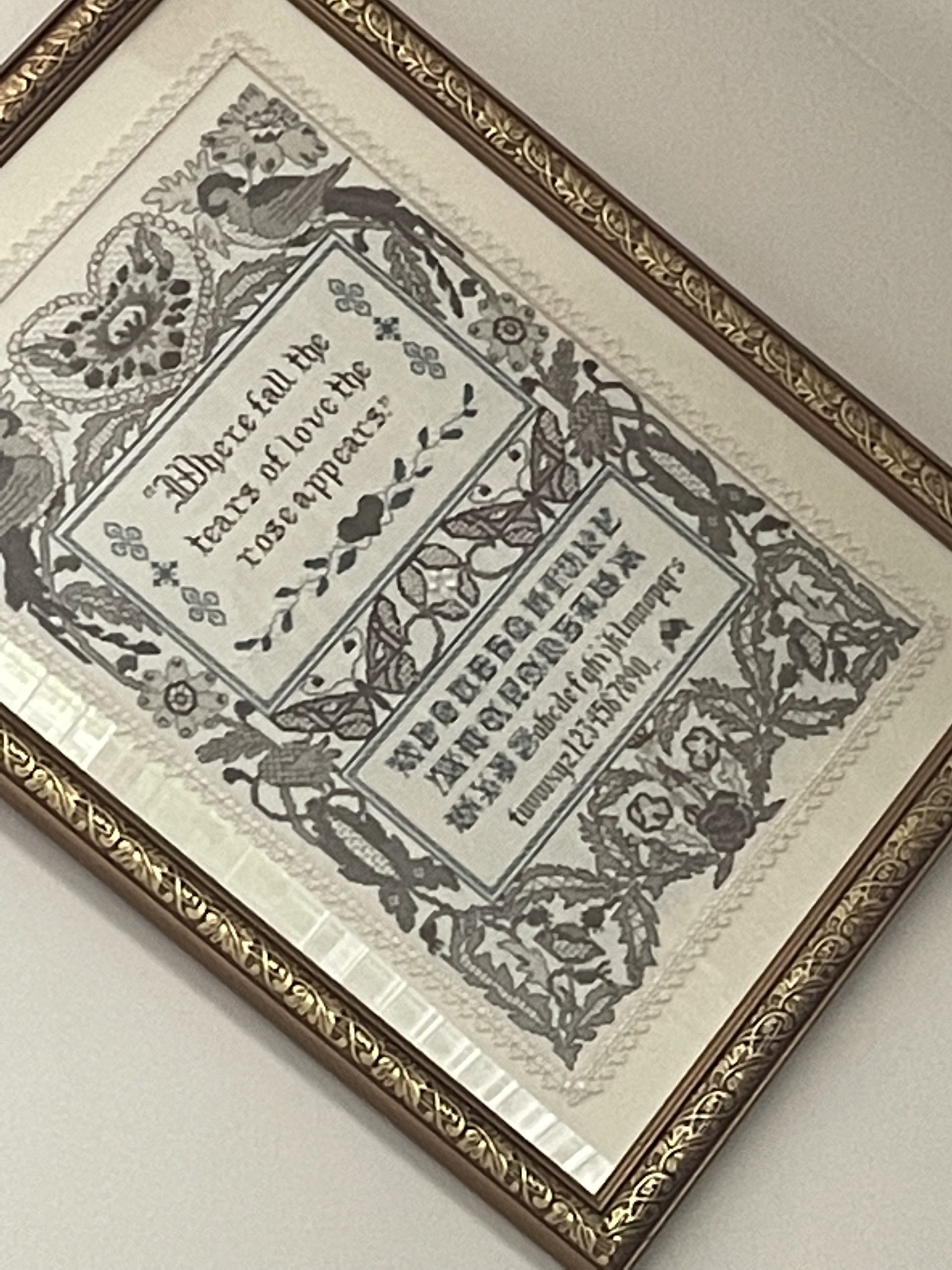
Mabel gifted us a beautiful cross-stitch of the Twenty-Third Psalm and went so far as to have it matted and professionally framed. When we took it home I knew exactly where I wanted to hang it; right outside of our bedroom door in the hallway so that every time we walked out, it would be the first thing we saw, reminding us of the gift, the giver and the promise it contained.
I AM NOT A HANDY MAN
I didn’t look for a stud to put the nail to hang the picture.
I didn’t even put up a super-duper wall hanger that would have been just as sturdy as nailing it into a wall stud.
I just eyed it up and put a nail in and hung the piece of art.
I have no idea why framed art like that has a way of falling down at 3:00 a.m. instead of 3:00 p.m. but that’s exactly what happened and when I heard the crash, I knew immediately it wasn’t a burglar, but a poorly hung picture. 
We all have that picture, don’t we? It is the picture that each of us have been gifted or maybe even painstakingly painted ourselves; and not only paint but we frame it; we make sure we put it in the best of mats and it has glare-less glass over top of it so we could see it from any angle without any kind of shadowy, distorted glares. This preciously framed picture is the only one of its kind. It includes those we have put in our picture, who have made up our lives and painted all of the intricate strokes that would have made it impossible for us not to be US.
It is reflective our pristine PLAN A with no forethought of any kind of a PLAN B
It is THAT PICTURE, the one and only un-replicated ONE that we treasure most; that most often falls from the wall, no matter how it seems to be secured. The one-of-a-kind-picture that we have painted for our lives, for our family, for our loved ones; it’s that picture that we hang on the wall and whether we first find a stud or whether we wall anchor it, somehow, someway, that picture, usually in the middle of one of the dark nights of our souls, without any warning whatsoever, falls and gets 100% obliterated; it gets smashed, the glass, the frame, the mat. The Vision.
The actual picture itself gets destroyed and we never can put it back together again because it is that obliterated. Isn’t that our life? It doesn’t matter how many goals we have set. It doesn’t matter how many New Year’s Resolutions we’ve made and actually kept; It doesn’t matter how expensive the pen we’ve used to write our script on a mystical pad; it doesn’t matter how we dream, we wish, we deem it all to be; IT IS HOW it all turns out to be, despite of all of those other concerted efforts. OFTEN it does not turn out to be that way. OUR WAY. . .
We are all a collection of jagged, smashed pieces; broken pictures fallen off the wall; constantly attempting to gather and putting together pieces that never can be put together again.
THE WORST PART. . .
We seldom see the good news of the never-to-be-put-together-again-picture we’ve held so dear to us.
THE TRUTH. . .
Sometimes it takes a good picture smashing to have what could have never been imagined. It may never be expensively matted, framed or professionally hung, but in living-vivid-color, it’s as real as your heartbeat and more desperately needed than your next breath.
The picture of the PRESENT MOMENT is never perfect, but it is very real and even more,
EvOlViNg. . .
It just could be THAT PICTURE might be better than the one that we put on the wall,
the one we grieve the most;
Crooked as it may be
keeps us from seeing
THAT PICTURE. . . .
Have you ever slept like a baby. . .
Most of us do
W H I C H
is not always as peaceful as we would choose;
NO
we may not wake up
needing to be fed
or changed
but. . .
They tell us we should sleep like a baby
well, I don’t know about you
but as a baby I didn’t sleep so well
sometimes I still don’t
. . .NOW
don’t get me wrong
I’m the first guy who’s head hits the pillow
asleep within moments
literally
in fact when listening to music at night
I usually don’t make it through the first song
BUT
staying asleep
that might be a different matter
and then getting back to sleep after you wake up that might be a whole Nother matter to because once your mind starts wandering or racing or thinking or having that monkey mindedness about it, it’s like somebody shakes the snow globe of your mind and for whatever time you have left before you get up well the snow globe never settles does it.
SO
what’s the cure
because finding that cure
would be a gazillion-billion-dollar business
but most often it doesn’t come
in the form of a pill
it’s not a honey-thickend-nectar
that you can drink
it is certainly not some magic potion
you just need to rub on a certain spot
on your body. . .
Do you count sheep.
Say the alphabet ~~backwards.
Pray.
Count your blessings.
Meditate.
Breathe exercises or ___________________
well, you fill the in the blank
which often stays blank. . .
WHAT’S YOUR GO TO. . .

Maybe it’s not so much
what gets you to sleep
or what keeps you to sleep
but what allows you to rest
when you’re not asleep. . .
ANSWER ME THAT
and it’ll give a new meaning to
D R E A M
S W E E T L Y

ARE YOU ONE. . .
I’ve had some of my greatest dreams
why I’ve been open-wide-eyed awake
. . .YOU?
I schedule time
R E G U L A R L Y
to do some serious
MIND WANDERING
and it’s brought about
not only
blog posts
presentations
sermons
CHUCK-IT’S like:

a n d

a n d

. . .and so many others you’ve yet to even glimpse yet
because what once was criticized often to me
from countless Teachers and Professors
who claimed that I wasn’t
FOcusEd
and I’ll never get anywhere
D A Y D R E A M I N G
had no idea
that it was all of the puzzle pieces
that were coming together
willy-NillIE
to make up
mE. . .
IT ALL MADE ME START
w o n d e r i n g
exactly WHAT:
JILL SUTTIE, Psy.D., is Greater Good’s former book review editor and now serves as a staff writer and contributing editor for the magazine. She received her doctorate of psychology from the University of San Francisco in 1998 and was a psychologist in private practice before coming to Greater Good.
Jill game me some new insight and made me a big believer in daydreaming now and then—especially when I’m out walking. There’s something about being in nature, making motion that helps me let go of daily cares and allows my mind to wander where it will, which feels great and often jumpstarts my creativity as a writer and a speaker.

I admit, though, I’ve been troubled by research showing how mind-wandering could make me less productive or depressed—the last thing I need! But it turns out this gap between personal experience and science may best be explained by how researchers have lumped together different kinds of mind-wandering. Not all research has differentiated between depressive rumination (like replaying an ongoing disagreement with our spouse in our minds) and pleasant daydreaming (letting our minds wander freely).
Now, some newer science is painting a more nuanced picture of what happens to us when we let our minds wander. Though the research is young and growing, it suggests that daydreaming may actually make us happier and more creative—if we do it the right way.
Anecdotally, mind-wandering has been associated with creativity for centuries. But this link to creativity may depend on the type of mind-wandering you do, as a new study by the University of Calgary’s Julia Kam and her colleagues suggests.
In this study, researchers used electroencephalogram technology to see what happens in our brains when we are engaged in different types of mind-wandering. To do that, they had people perform a mundane, repetitive task and interrupted them occasionally to see what they were thinking about, while continuously monitoring their brain activity.
Some participants reported thoughts that Kam calls “constrained,” involving things like ruminating over a fight with a spouse or thinking about how to manage a work problem. While these thoughts were not related to the task at hand, they were still somewhat focused. Others reported thoughts that were “freely moving”—meaning, they skipped from thing to thing—perhaps daydreaming about a future vacation in Italy, then wondering if they needed a new bathing suit, then fantasizing about an old flame.
When Kam and her colleagues matched people’s thoughts to their concurrent brain activity, they found signature patterns for different types of mind-wandering. In particular, freely moving thoughts were associated with increased alpha waves in the brain’s frontal cortex—a remarkable and novel finding, says Kam.
“What’s really striking about finding this neural marker is that it’s been implicated during studies of creativity,” she says. “When you introduce alpha oscillation in the frontal cortex, people perform better on creative tasks.”
This kind of brain activity maps well on to one particular aspect of creativity—divergent thinking or thinking “outside the box,” she says. When you’re generating ideas, you want to be able to go in many directions and not be constrained, which freely moving thought allows.
Mind-wandering has also been shown to enhance convergent thinking: what happens after you’ve brainstormed ideas and have to pick the best of the bunch, she adds. So, it’s likely that mind-wandering serves a creative purpose.
“If a problem has built up in your mind and you need to find a solution, letting it go into the background for a bit probably helps,” she says. “Mind-wandering facilitates the kind of solution that just comes to you, as in a lightbulb moment.”
This mirrors results from a 2015 study conducted by Claire Zedelius, formerly of the University of California, Santa Barbara. She looked at how mind-wandering affected people’s performance on a creativity test where they have to come up with a novel word (e.g., “food”) that fits with three seemingly unrelated words (e.g., “fish, fast, and spicy”). She found that people who mind-wandered performed better on this task, the answer coming to them in a flash rather than through methodically testing different solutions.
“People don’t even know how they got to the solution—it was just suddenly there,” she says. “Mind-wandering helps with ‘aha’ types of problem-solving.”
In a more recent study, Zedelius looked at the contents of people’s thoughts to see how that related to everyday creativity (outside of a lab setting). Participants, including some creative writers, were prompted via cell phones throughout the day to report on the nature of their thoughts and, at the end of the day, how creative they had been. Findings showed that people’s minds often wandered to fairly mundane things—like planning for a later shopping trip—and that these thoughts had no effect on creativity.
But when people’s minds wandered in more fantastical ways (playing out implausible fantasies or bizarre, funny scenarios, for example) or in ways that seemed particularly meaningful to them, they tended to have more creative ideas and feel more inspired at the end of the day, too. Interestingly, this was true for both writers and everyday people.
“Writers probably do this for their creative process all the time—thinking through stories, considering ‘what ifs’ or unrealistic or bizarre scenarios,” says Zedelius. “But lay people will also do this more to be more creative.”
This suggests that the link between mind-wandering and creativity is more complicated than previously thought. It seems to depend on how freely moving your thoughts are, the content of your thoughts, and your ability to be removed from everyday concerns. No doubt, this explains why my daydreaming on a hiking trail has led to song or story ideas that seem to bubble up from nowhere.
Prior research suggests a wandering mind is an unhappy mind: We tend to be less happy when we’re not focused on what we’re doing. And that’s likely true, if you tend to rehash past mistakes or replay social flubs when your mind wanders, or if your mind-wandering keeps you from fulfilling your goals.
Again, the content of wandering thoughts makes a big difference. For example, as one 2013 study showed, when people found their wandering thoughts more interesting, their moods actually improved while mind-wandering. Similarly, other studies have found that thinking about people you love or thinking more about your potential future than about what happened in the past produces positive results.
How you use mind-wandering may also be important. In some cases, people intentionally mind-wander—something that has been mostly unexplored in the research, but likely has distinct effects. As one 2017 study found, people who use daydreaming for self-reflection typically have more pleasant thoughts than people who simply ruminate on unpleasant experiences.
There is even some evidence that mind-wandering may be more of an antidote to depression than a cause. People who are depressed may simply replay events from their past to better understand what happened to cause their dark mood and avoid future problems. Also, when researchers studied whether a negative mood preceded or followed a mind-wandering episode, they found poor moods led to more mind-wandering but not vice versa, suggesting that mind-wandering may be helping people feel better.
Now, findings from a 2021 study suggest that mind-wandering that is more freely moving can actually improve your mood.
In this study, participants were prompted randomly via cell phone over three days to report how they were feeling (positive versus negative) and how much their thoughts were freely moving and related to what they were doing (or not).
After analyzing the data, the researchers found that when people’s thoughts were off-task, they generally felt more negative—similar to what earlier findings showed. But if their thoughts were free-moving, it had the opposite effect, helping people feel happier.
“Our findings suggest there might be positive aspects of mind-wandering,” the researchers conclude.
Again, I find that science supports my own experience. If I simply put myself in a space that lets my mind move freely, I don’t get depressed. On the contrary, I’m happier because of it.
While the research on this is still young, it does indicate there may be a right and a wrong way to mind-wander.
Kam warns that mind-wandering when you need to be focused on a task (or risk hurting yourself or others—like if you’re driving or doing surgery) could be problematic. But, she says, if you let your mind wander when you’re doing mundane tasks that don’t require focus—like knitting or shelling peas–it may help you feel better or come up with creative ideas.
“The context and the content of your mind-wandering is actually really important. It plays a role in whether you get a good outcome or a not-so-good one,” she says.
Though many of us have a default mode that takes our mind to dark places when we aren’t busily engaged, that doesn’t mean we have to stay stuck there. If we can divert our thoughts from those darker places, we’ll likely get more out of mind-wandering.
Kam thinks practicing mindfulness could help with that, as long as it increases awareness of our thoughts and alerts us when we’ve strayed into problematic thinking, which could then help us redirect our mind-wandering.
“Just having more control over when mind-wandering happens and the kind of thoughts that you have would be very useful,” she says.
Zedelius also says awareness matters. As many study participants told her, they had never paid much attention to where their minds went before being in her study, but found the process eye-opening.
“They would say, ‘I’ve become aware of patterns in my thoughts that I never noticed before—what I get drawn to,’” she says. “It makes me wonder if the repeated probing we do in our experiments could not just be used as a measure, but as a type of intervention, to see if awareness changes over time.”
Of course, even though daydreaming may be good for us, it gets a pretty bad rap in American culture. Americans tend to pride themselves on their strong work ethic—often translated as working hard for long hours with complete focus.
But people are not built to be “on” all of the time. Taking a mind-wandering break might be good not just for our creativity and happiness, but also for our productivity, especially if we are in jobs requiring focused attention that is draining to maintain. And, as long as it’s employed during times when complete focus isn’t required, it may improve our well-being without hampering performance.
We shouldn’t need an excuse to mind-wander, given that it’s part of our human inheritance. Besides, we’ve hardly begun to recognize what it can do for us, says Zedelius.
“My hope is that people will explore the limits of mind-wandering a bit more and try to mind-wander in a way that is bigger, more fantastical, more personally meaningful, and further into the future,” she says. “If people just really allowed themselves to playfully use this tool, they might be able to focus on creative solutions to big problems.”

HOW ABOUT A LITTLE MIND WANDERING
Psssssssssssssssssssssssssssssssssssssssssssst:
Dressing up or down
is optional
but the benefits
are
UNlimITEd
and
COUNTless