The Woods Are Lovely — But They’re Also Dark
I used to think I had Robert Frost figured out. . .
(I mean, come on, I was a hot-shot-I-know-everything poetry-poet-English major)
Frost was the safe poet.
The classroom poet.
The “two roads diverged” guy printed on posters in guidance offices.
Snow. Woods. Quiet reflections. Soft wisdom. . .
I didn’t dislike him.
I just didn’t think he had anything sharp enough to cut me.
Then I learned a little about what was behind the closed curtain of his life.
And I haven’t read him the same way since.
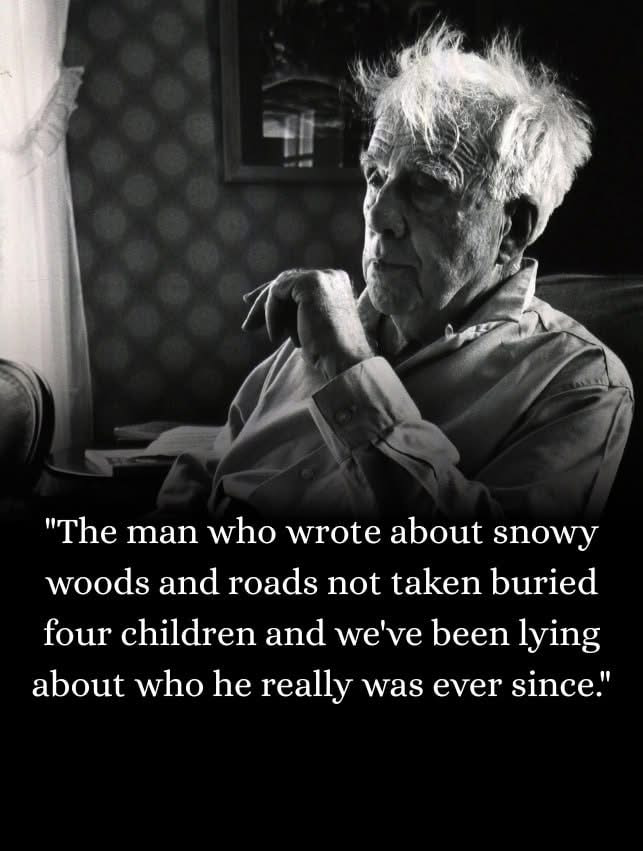
He buried four of his children.
F O U R. . .
One died at three years old.
One as an infant.
One at twenty-nine after childbirth.
One by suicide.
Another daughter struggled with severe mental illness.
His wife, Elinor Miriam White, endured loss after loss until her own body gave out.
And suddenly the poems didn’t feel like nature sketches.
They felt like someone breathing through pain.
When I read:
“The woods are lovely, dark and deep…”
I don’t hear or feel cozy winter anymore.
I hear that quiet temptation we don’t always talk about.
The temptation to stop.
To sit down in the snow of our own exhaustion.
To not keep pushing when life feels heavier than we expected,
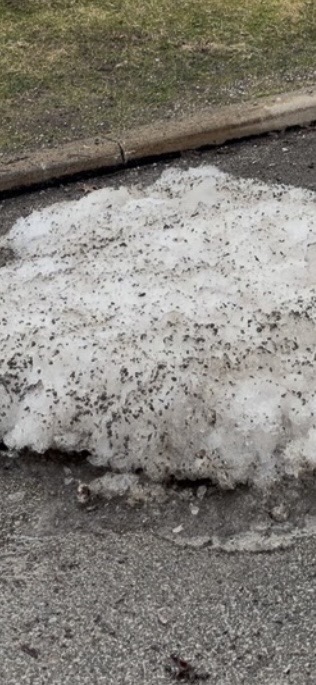
like an avalanche that is anything but gentle snowman-like.
Maybe you know that feeling too.
Not dramatic. Not cinematic.
Just tired.
And then the line that follows:
“But I have promises to keep,
And miles to go before I sleep.”
That doesn’t sound poetic to me anymore.
It sounds like a decision.
A choice to keep showing up.
And that hits differently when you realize the man writing it had already buried a child — and would bury more.
I used to treat “The Road Not Taken”
like a badge of independence.
Be bold.
Choose differently.
Take the path no one else takes. . .
But Frost wrote it with irony, partly inspired by his friend Edward Thomas, who constantly second-guessed his decisions.
The roads in the poem are described as nearly the same.
That undoes me a little.
Because I’ve spent so much time wondering if I chose the right road.
What if I had. . .
What if I hadn’t. . .
What if I’d been braver. . .
But maybe the power isn’t in choosing perfectly.
Maybe it’s in walking fully. . .
What moves me most isn’t just his grief.
It’s that he kept going.
Before success, he failed — at farming, at stability, at being recognized. He was nearly forty before his poetry truly took off. He moved his family to England out of equal parts desperation and hope.
I need that reminder.
Because sometimes I feel behind. Sometimes I feel late. Sometimes I feel like everyone else got the map earlier than I did.
And then I remember: timelines are illusions.
You can begin again at almost any age.
There’s a story about him standing at the inauguration of John F. Kennedy at eighty-six years old. The sun was too bright for him to read the poem he’d written.
So he set it aside and recited another from memory.
No panic. No apology. Just presence.
I think about that a lot.
Life will glare at you sometimes. The plan won’t work. The page will blur.
What do you do then?
You offer what you’ve carried inside you all along.
Learning the fuller truth about Frost hasn’t made me admire him in a distant, pedestal way.
It’s made me more honest with myself.
It’s made me ask:
Where am I tempted to stop?
Where am I romanticizing a different road instead of walking the one in front of me?
Where do I need to keep a promise — even quietly?
And maybe the bigger question:
How do I live in a way that inspires the people around me to reflect on their own woods?
Not by preaching.
Not by pretending life is easy.
But by being honest about the dark parts — and choosing to walk anyway.
Because maybe that’s what strength really looks like.
Not grand speeches.
Not perfect choices.
Just this:
The woods are lovely.
They are dark.
They are deep.
And still —
WE WALK. . .
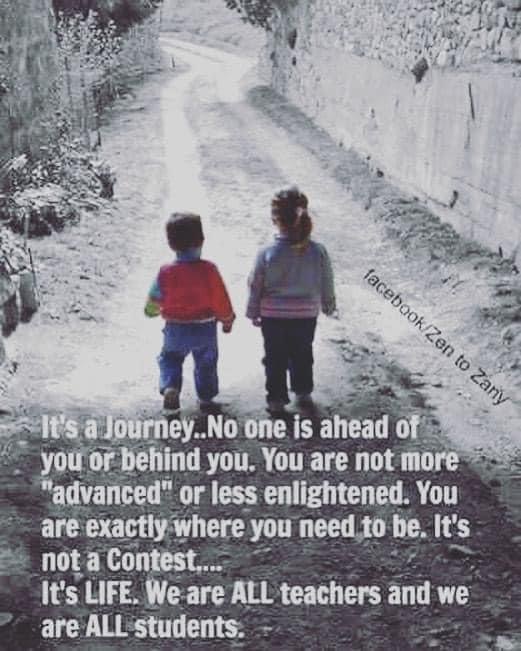
we walk on and on and on and. . .